- Home
- >
- News
- >
- Industry News
- >
- What is the selection and arrangement of rubber fenders?
What is the selection and arrangement of rubber fenders?
1. Rubber fender layout spacing
The spacing and height of rubber fenders are very important. It is necessary to ensure that the ship does not directly contact the dock wall at the most unfavorable berthing angle allowed by regulations, and to ensure that the ship can safely berth at different tide levels and water conditions. Has strong adaptability to ships of different tonnages.
Among them: r ≤ - minimum longitudinal curvature radius of the bow (M); H ≤ - The height of the fender after compression (M).
This ship is curved both vertically and longitudinally. Through analysis, the vertical curve of the bow of the ship affects the horizontal spacing of the vertical fenders, while the changes in the vertical curve of the ship's hull and the unloaded vertical curve, as well as the fully loaded freeboard, affect the layout of the top floor vertical fenders and horizontal fenders. The author believes that when selecting the spacing L between high pile docks, the horizontal spacing P of L should not exceed the vertical fenders, so that the vertical fenders on the ship can first withstand greater impact forces when docked. And transfer it to the end side rack bearing.
2. Layout of vertical fenders
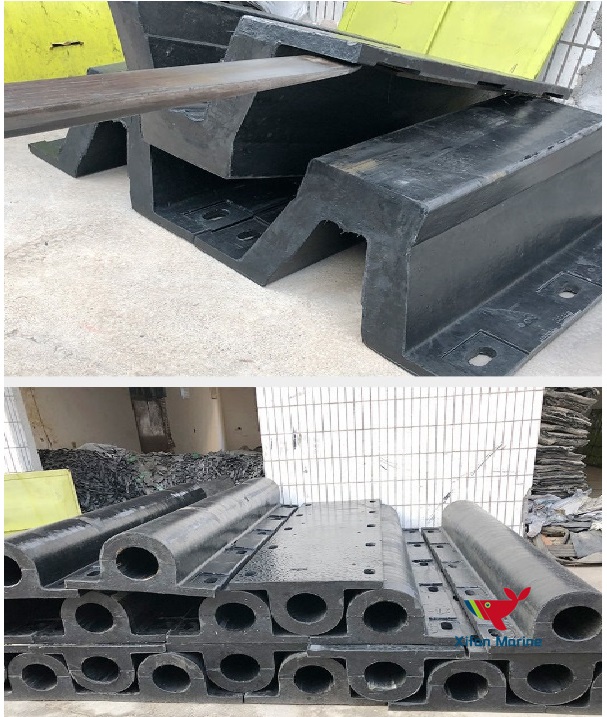
The layout of rubber fenders should protect both the ship and the structure of the dock, and minimize the number of fenders while ensuring energy absorption. On the one hand, in order to reduce investment, it is also necessary to consider attracting some varieties of rubber fenders. The energy response characteristics, such as drum type and V-shaped rubber fenders, have a deformation of only 20% to 30%. When the energy is still very small, the reaction force has reached its maximum value. If multiple fenders are arranged in one place, when the ship contacts and compresses the fenders at the same time, the fenders may not have been able to absorb the effective energy of the ship, but the reaction force has reached its maximum value and the structure has undergone several times. Reaction force. Therefore, the regulations stipulate that the impact force on the dock should be determined based on the rubber fender in contact with the ship. The ship may have come into contact with several rubber fenders, and multiple reactive forces should be considered. In response to this situation, rubber fenders and crash barriers were used in the design of large and medium-sized docks
3. Vertical fender bottom elevation control
The ship is fully loaded with small free board height, such as a 1500t deck barge, with a depth of 3.5m and a draft of 2.6m when fully loaded. The ship can dock at a height above the water surface. In order to provide sufficient contact length between the hull and fenders and ensure the safety of the dock and the vessel, fenders are usually extended below the design low water level. Considering the difficulty of installing fenders underwater, fenders are generally extended by 0.6-1.0m below the designed low water level. The sea vessel is loaded with a large free board height and a 40000 ton general cargo ship, with a depth of 19.0 meters and a draft of 12.3 meters when fully loaded. The height of the ship above the water surface is very large, and there is sufficient contact length with the fenders, so the fenders are usually extended. Approaching the design low water level.
4. Control of vertical fender top height
When designing for high water levels, attention should be paid to the tilting of the vessel, such as a 5000 ton vessel with a depth of 9.0m and an unloaded draft of approximately 3.0m. In high water level design, if the height of the top of the fender is too low, the hull will tilt towards the shore, and if the height of the fender is too low, the ship will tilt towards the shore. Easy to cause accidents. Therefore, from the perspective of setting up fenders, the ship's line shape should be identified and the height of the fenders should be reasonably determined.
Layout of 5 lateral fenders
Through the analysis and calculation of the ship type line diagram designed in the past, it is shown that when the row spacing L of the high pile wharf in the middle and lower reaches of the Yangtze River is less than the vertical fender spacing P, horizontal fenders cannot be set except for the top layer due to the large curvature radius of the ships. The vertical fenders of the dock usually come into contact with ships operating outside the berth. The main function of the top horizontal fender is to prevent the vessel from coming into contact with the dock during high water levels. In the past, it was customary to choose the same type of horizontal and vertical fenders, mainly the D-type. Not only is the selection of horizontal fenders inappropriate, but the stress is also unreasonable. For top horizontal fenders, energy absorption is not the main factor in their selection. The main consideration is that the friction between the fender and the ship's side should be small, and the installation strength of the fender should be high. The installation strength of GD fender is twice that of D fender, and its energy consumption is about 30% higher than that of D fender. It is suitable for horizontal layout of the top layer of large and medium-sized docks in the middle and lower reaches of the Yangtze River. The top horizontal fenders should be spaced apart, and their positions and quantities should be determined based on the analysis of the top elevation of the vertical fenders.