
- Home >
- Why Marine Electric Cooking Ranges Are Essential for Modern Shipboard Galleys
Why Marine Electric Cooking Ranges Are Essential for Modern Shipboard Galleys
As the global shipping industry accelerates its transition toward greener and lower-carbon operations, “all-electric galleys,” which replace open flames with electric heating, have become an increasingly common configuration for modern ocean-going vessels, commercial ships, and offshore facilities.
However, professional Marine Electric Cooking Ranges are fundamentally different from standard household stoves. The key reason is the demanding operating environment of a vessel. Unlike residential kitchens, shipboard galleys must operate safely and reliably under conditions involving vessel movement, vibration, humidity, salt spray, and complex electrical systems.
For this reason, marine cooking equipment is specifically engineered to meet the functional, structural, and safety requirements associated with shipboard applications.
The Core Differences Between The Two Fall Into Four Critical Dimensions:
First, Mechanical Design for Anti-Rolling Stabilisation
Domestic cookers are primarily designed for stable terrestrial environments, where level surfaces and predictable operating conditions can be assumed.
Marine vessels, however, may experience rolling, pitching, vibration, and sudden movements caused by wind, waves, and vessel operations. These conditions can cause cookware to move or tip over, potentially resulting in hot food spills, scalding injuries, or other galley safety hazards.
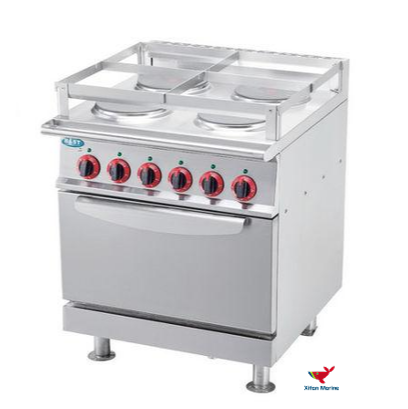
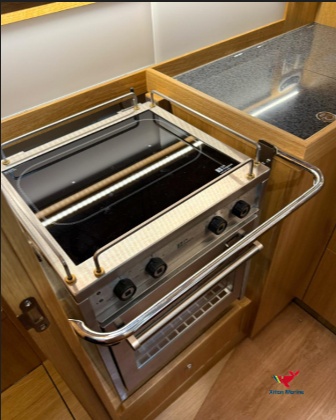
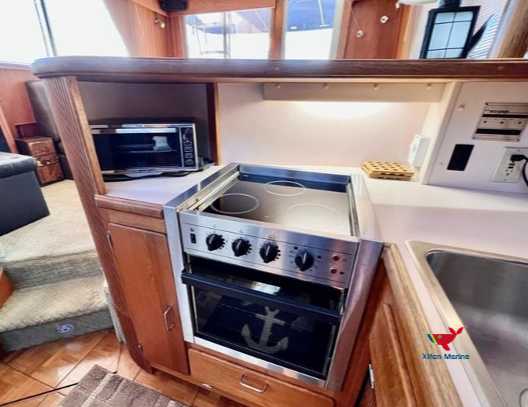
To address these challenges, professional Marine Electric Cooking Ranges can incorporate specialised features such as storm rails, pot holders, and other cookware-retention systems. These features help keep pots and pans stable during vessel movement.
The cooking unit itself also needs to be securely installed. Instead of simply placing the appliance on a countertop, marine ranges are typically designed for firm installation using welded flanges, heavy-duty bolts, or other appropriate fixing methods according to the vessel's installation requirements.
This combination of equipment stability and secure installation is an important difference between marine galley equipment and conventional household cooking appliances.
Second, High-Standard Grid Adaptability
Household cooking appliances generally operate on standard civilian electrical systems, such as single-phase 220V or 110V power supplies.
A vessel, by comparison, operates as an independent electrical system. Shipboard generators supply power to propulsion systems, pumps, deck machinery, ventilation systems, lighting, navigation equipment, and numerous other electrical loads.
The starting and stopping of high-power equipment can therefore create changes in the onboard electrical environment. Marine cooking equipment needs to be appropriately designed and specified for the vessel's electrical system.
Depending on the vessel and project requirements, Marine Electric Cooking Ranges may be configured for three-phase marine power supplies such as 380V, 440V, or 690V.
Electrical components, control systems, heating elements, and protective devices must also be selected according to the applicable voltage, frequency, power capacity, installation environment, and vessel specifications.
For this reason, selecting a marine electric range is not simply a matter of choosing the same appliance used in a residential kitchen with a different voltage. The equipment must be properly matched to the vessel's electrical system.
6
Marine Electric Cooking Ranges – XIFAN MARINE
Third, High Corrosion Resistance and Waterproof Protection
The marine environment presents another major challenge: salt, moisture, humidity, and corrosion.
Long-term exposure to salt-laden air and high humidity can accelerate corrosion of metal surfaces and electrical components. Standard household appliances are generally designed for controlled indoor environments and may not provide the level of durability required for demanding shipboard applications.
Professional marine cooking equipment therefore commonly uses 304 or 316 stainless steel, depending on the equipment specification and application. These materials provide strong corrosion resistance while also offering the durability required for professional galley environments.
Water and moisture protection are also important considerations. Shipboard galleys require regular cleaning, and equipment may be exposed to water during washdown operations. Appropriate enclosure design and ingress protection help protect electrical components against moisture and other environmental factors.
For marine operators, therefore, material selection is not simply an aesthetic consideration. Stainless steel construction, component protection, welding quality, surface treatment, and overall equipment design all contribute to the long-term reliability of Marine Kitchen Equipment.
Fourth, Stringent Classification Society Industry Approval
Safety is one of the most important considerations when selecting cooking equipment for ships and offshore applications.
A galley fire onboard a vessel can have serious consequences because evacuation, firefighting, and emergency response are considerably more challenging at sea than in a conventional building.
Unlike household appliances, marine galley equipment may be subject to specific maritime regulations, project specifications, and classification requirements depending on the vessel type, flag state, installation location, and customer requirements.
Depending on the project, relevant requirements may involve recognised classification societies such as China Classification Society (CCS), DNV, or Lloyd's Register (LR).
Electrical components and cabling may also need to comply with applicable marine standards, including requirements related to flame retardancy, low smoke emission, and halogen-free materials.
For shipyards, shipowners, and marine equipment suppliers, understanding the applicable certification and classification requirements at the project planning stage is therefore essential for ensuring that the selected Shipboard Cooking Equipment is suitable for its intended application.
Marine Electric Cooking Ranges – XIFAN MARINE
Conclusion
Although a Marine Electric Cooking Range may appear similar to a household stove in terms of its basic cooking function, the engineering requirements behind the two types of equipment are significantly different.
Marine cooking equipment is designed with the shipboard operating environment in mind, including vessel movement, vibration, electrical-system requirements, saltwater corrosion, humidity, cleaning conditions, installation stability, and applicable marine safety requirements.
These specialised design considerations make marine electric ranges an important part of modern shipboard galley systems. From stainless steel construction and secure installation to electrical adaptability and protection against demanding environmental conditions, every detail contributes to reliable and safe galley operation.
As the maritime industry continues to move toward more efficient and environmentally conscious vessel designs, XIFAN MARINE remains focused on providing professional Marine Cooking Equipment, Marine Galley Equipment, and Marine Electric Cooking Ranges for modern vessels and offshore applications.


