- Home
- >
- News
- >
- Industry News
- >
- Xifan Marine Efficient Marine Incinerator for Ship Waste Management
Xifan Marine Efficient Marine Incinerator for Ship Waste Management
Operation Management and Daily Maintenance of Xifan Marine Incinerators
Views: 54 Author: Xifan MARINE Publish Time: 2026-09-18 Origin: Site
Advanced Operational Excellence of Xifan Marine Incinerators
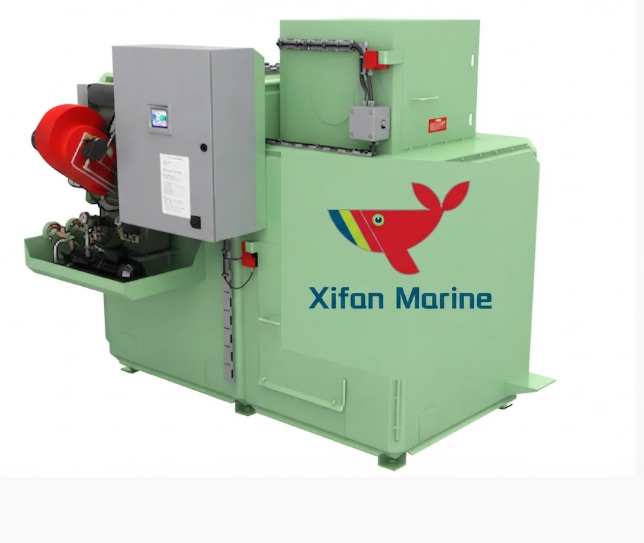
The incinerators manufactured by Xifan Marine feature an operator interface designed with both user-friendliness and simplicity in mind. Compared to some incinerators of similar types, they are equipped with a practical sludge settling tank. This configuration enables continuous combustion without stopping the unit, significantly improving sludge treatment efficiency. Additionally, these incinerators are equipped with intelligent adjustment functions that automatically optimize the fuel supply rate and air pressure parameters based on fuel quality and furnace temperature. This not only accelerates the combustion rate but also effectively reduces the occurrence of sudden flameouts when burning sludge.
In terms of the "ash removal" program design, these incinerators also highlight their user-friendly advantages. During the ash cleaning process, dust does not disperse into the engine room but is directly discharged outside the ship via the flue gas fan, preventing pollution of the engine room environment. Moreover, activating this function when loading waste helps reduce the accumulation of harmful gases inside the furnace, further ensuring equipment operational safety and the health of operating personnel.
Core Operating Procedures for Solid Waste Mode
1. Waste Processing Guidelines
The solid waste incinerated on this vessel mainly consists of oil-absorbent cotton yarn and paper-based waste, while plastics, metals, and glass are strictly prohibited.
Hazardous liquids with a flash point below 60°C and other dangerous materials must not be fed into the furnace to prevent fire or explosion.
High-calorific materials over 1 kg should be mixed with low-calorific substances to prevent excessive flames, sudden negative pressure increases, and fan surges.
Oil-absorbent cotton yarn must avoid direct contact with high-temperature refractory bricks, and the "ash removal" procedure should be activated during loading to discharge flammable gases safely.
High-moisture or low-combustibility materials must be placed on the surface of the waste layer to utilize heat and reduce auxiliary fuel consumption.
Lightweight materials must be bagged or placed underneath other waste to avoid being sucked into the flue and blocking the damper or fan.
Total solid waste volume must not exceed two-thirds of the furnace capacity to ensure adequate oxygen supply and combustion space.
Meltable materials like glass are prohibited as they adhere to the furnace surface and form hard, removable-resistant deposits.
2. Garbage Combustion Sequence
Pre-sweeping: Expels residual flammable gases before ignition to reduce explosion risks; display shows "Pre-sweeping" for at least 15 seconds.
Ignition Program: Automated flame check requires operator response within 5 seconds if a signal is detected, preventing secondary startup delays and high temperature/red-hot wall issues.
Solid Waste Incineration: Flue damper regulates automatically to balance vacuum and heating rate; manual stop is recommended at 300°C to allow self-sustained burning up to the 90-minute preset time limit.
Post-sweeping and Cooling: Vacuum adjusts to -18mm; cooling fan operates until temperature drops below 100°C, though manual stop is permitted at 220°C with caution against spontaneous combustion.
3. Ash Removal Execution
Press the "Door Open" button fully, then press "Ash Removal" to automatically close the flue gas damper and prevent engine room dust dispersion.
Following a 30-second delay, the flue gas fan activates to extract ash outside the ship, and operators can choose "Confirm" or "Cancel" on the system confirmation page.
Sludge Oil Incineration Management
1. Sludge Oil Processing & Impurity Control
Filter large-particle impurities regularly via the sludge pump filter and auxiliary fine-mesh screen to minimize hard slag formation.
Control water content carefully; optimal evaporation is achieved at 97°C settling tank temperature with non-viscous sludge and intermittent vent condensate.
Handle variable waste oils from lube, fuel, and sludge tanks differently, ensuring proper draining and temperature control between 60°C and 70°C.
Prevent bottom blockages in settling tanks from continuous evaporation to protect level gauges and transfer pump suction efficiency.
Maintain post-processing service tank temperatures at 80°C–85°C for 380CST sludge or 75°C for 180CST low-sulfur sludge, keeping maximum limits below 92°C to prevent seal aging.
Close the service tank heating valve after combustion starts or utilize thermal balance-type valves to avoid high-temperature alarms.
Ensure diesel return lines lack closed valves or blocks to protect the oil pump, utilizing bypass safety valves and manual KM2 relay priming after long shutdowns.
Avoid direct draining of stratified wastewater to prevent oil-water separator pollution, preferring heating and evaporation methods.
2. Sludge Oil Combustion Stages
Heating & Pre-sweeping: Pauses pre-sweeping until oil reaches 60°C, followed by standard gas purging.
Ignition & Sludge Burning: Diesel nozzle heats furnace to 650°C before starting the metering pump at 20 Hz, transitioning to independent combustion when furnace temperature reaches 850°C to stabilize between 985°C and 1035°C.
Maintain circulation pressure at 0.04 MPa, atomizing air pressure at 0.2 MPa, and adjust parameters flexibly based on water content and calorific value.
3. Slag Handling Protocol
Conducted strictly after the incinerator enters standby mode following standard ash removal procedures and personal protective measures.
Mixed Incineration & Daily Maintenance
Solid Waste + Sludge Oil Mode Logic: Automatically shifts from solid waste to sludge oil mode when solid waste calorific value drops, provided diesel is in high-fire state and furnace negative pressure is under -25 mm continuously for 3 seconds.
Daily Maintenance Key Areas:
Diesel Line: Bleed lines regularly and check after filter cleaning to ensure smooth pressure building.
Sludge Oil Line: Clean and inspect sludge oil guns and inline filters to eliminate carbon deposits and blockages.
Air Line: Maintain daily 7–8 BAR air supplies, clean filters, and check for leaks to ensure optimal atomization.
Condition Adjustment: Monitor flame patterns, exhaust smoke, and carbon buildup ("hillock" shapes), adjusting atomizing pressures and metering pump frequencies dynamically.
Furnace Cleaning: Inspect temperature probes, oil nozzles, and pressure pipe connections regularly to prevent clogs and extend operational lifespans.


